Imagine the scene: you're sitting in front of your computer screen, your heart racing. The email you've been waiting for has finally arrived: "We've invited you for an interview". The initial euphoria quickly gives way to a familiar anxiety. What will they ask? How will I do at interview? This feeling of being unprepared is one of the biggest obstacles standing between a candidate and their dream job. But what if I told you that you had a powerful tool at your fingertips to turn that anxiety into confidence? ChatGPT, more than just a chatbot, can become your personal coach, available 24 hours a day to rehearse, refine and polish your answers until you feel absolutely prepared. Let's explore, step by step, how you can use this artificial intelligence to your advantage, creating a realistic and safe practice environment that will make all the difference on the decisive day.
Why practicing with an AI is a game changer in preparation
Traditional practice for interviews is often limited to reading common questions and thinking of answers mentally, or, in the best-case scenario, asking a friend to play a role. However, these approaches have significant limitations. Thinking up answers "in your head" doesn't test your ability to articulate under pressure, and a friend may not have the repertoire or impartiality needed to simulate an experienced interviewer. This is where ChatGPT emerges as a revolutionary resource. It offers a space for unlimited trial without judgmentYou can make mistakes, try out different approaches and repeat the questions as many times as you need to, without the embarrassment we sometimes feel when practicing with someone else. Have you ever stopped to think how many times you've failed to express an important skill simply because the question didn't come? With AI, you can explore varied scenarios and ensure that your full repertoire of skills is activated.
In addition to pure and simple repetition, interacting with an artificial intelligence develops a crucial skill: the structured improvisation. In a real interview, the flow of the conversation can take unexpected turns. ChatGPT, with its ability to generate dynamic dialogues, can surprise you with follow-up questions, suddenly change the topic or delve into a specific point on your CV. This trains your brain to remain agile and coherent, regardless of the path the conversation takes. It's cognitive training that goes far beyond memorizing ready-made answers. It builds resilience and adaptability, two attributes that are highly valued in any professional. Therefore, using AI is not about creating a robotic script, but about strengthening professional communication muscles so that they respond naturally and accurately when it matters most.
Setting up the scenario: how to instruct ChatGPT for a realistic simulation
The first step to a productive session is to set up your "virtual interviewer". ChatGPT is a flexible tool, but its performance depends directly on the quality of the instructions you provide. A generic prompt such as "simulate a job interview" will yield vague results. The key is specificity. Start by defining the context for the AI. Tell them the position you're looking for, the sector of the company and, if possible, a little about the organizational culture. For example: "Act as a senior interviewer for a Digital Marketing Analyst position at a technology start-up with an agile and innovative culture. The company values data, creativity and teamwork". This contextualization directs the focus of the simulation to the really relevant competencies.
Next, it's essential to establish the format of the interaction. Do you want a completely AI-driven interview, with one question after another? Do you prefer a more interactive format, where you can ask people to pause and reflect? Or perhaps a focus on specific technical questions? Communicate this clearly. A good prompt could be: "Let's simulate a full interview. Please start with introductory and cultural fit questions, then move on to technical questions about social media campaign metrics and finish with a behavioral situation. Ask one question at a time and wait for my full answer before moving on. Feel free to ask follow-up questions based on what I say". In this way, you take control of the dynamic and ensure that the practice meets your specific needs. For inspiration on different interview styles and questions, you can consult reference materials such as those from Gupy or GeekHunter.
Don't forget to ask for feedback. After each answer, you can instruct ChatGPT to analyze it. Ask it to evaluate the structure (did you use the STAR technique - Situation, Task, Action and Result?), clarity, conciseness and even the professional tone. For example, after giving an answer to a behavioral question, you could type: "Based on my last answer, give me feedback. Score the strengths and suggest an improvement to make the result more quantifiable". This analysis stage is where the real learning takes place, turning mere repetition into a continuous cycle of refinement. Remember: the richer the scenario you create, the more valuable and closer to reality the practice experience will be.
Mastering the different types of interview: behavioral, technical and case interviews
The world of interviews is diverse and each type requires different preparation. The great advantage of ChatGPT is its ability to adapt to all these formats, allowing you to train in a segmented way. Let's start with behavioral interviewsThese are questions that seek to understand how you acted in the past in order to predict your future behavior. They are famous for questions that start with "Tell me about a time when...". Here, the STAR technique is your best friend. Ask ChatGPT to focus on this type of question. An example interaction: the AI asks "Describe a situation in which you had to deal with a conflict within the team". You structure your answer with the Situation, the Task, the Actions you took and the Results achieved. Then ask the AI to check that all the elements of the technique have been covered in a clear and impactful way.
For technical interviewsIf you're a developer, precision is key. If you're a developer, you can ask ChatGPT to ask you questions about a specific language, such as Python or JavaScript, and even to propose solving small logic problems. If you're in finance, you can simulate questions about balance sheet analysis or valuation. The tip is to be extremely specific in the prompt: "Act as a Tech Lead and ask me 5 full-level technical questions about React Hooks, focusing on useEffect and useContext. Evaluate my answers and correct any misconceptions". This is a powerful way to review concepts and identify gaps in your technical knowledge before the actual interview. Platforms such as LinkedIn Learning offer courses that can complement this targeted technical study.
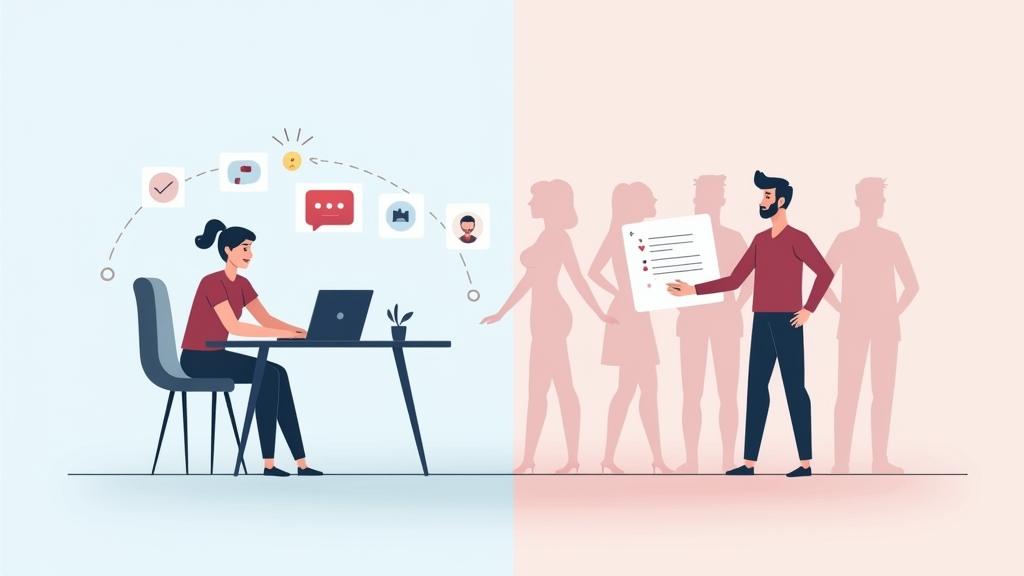
One of the most challenging formats is the case interviewsThey are common in consultancies and some business areas. They test your logical thinking, problem structuring and analytical skills. ChatGPT can be an exceptional partner here. You could ask: "Give me a case study on the entry of a new energy drinks company into the Brazilian market. Guide me through the resolution by asking questions to help me structure my analysis (problem definition, market segmentation, competitor analysis, recommendations)". AI can act both as the client who presents the problem and as the evaluator who questions its assumptions and conclusions. This practice helps them develop an analytical mindset and communicate their reasoning clearly and persuasively, skills that will impress any interviewer.
From rehearsal to excellence: refining content, virtual body language and dealing with the unexpected
Practicing the answers is only the first half of the journey. True mastery comes from refinement. Use ChatGPT as a critical mirror for the content of your speech. After a simulation session, ask for a summary of the skills your answers demonstrated. The AI might say: "Based on your answers, you did well with leadership and teamwork, but you didn't show any project management skills". This insight is invaluable! It shows you which points you need to reinforce in your next attempts. Also, work on conciseness. Many candidates get lost in details. Ask the AI: "Rewrite my last answer so that it's 30% shorter, while maintaining impact". Compare the versions and learn to save words without losing substance.
What about body language? Although ChatGPT can't see your gestures, it can help you train your body language. narrative and intonation. Ask: "In the answer I gave about overcoming failure, did my tone sound defensive or learning?". The AI can analyze your choice of words and suggest adjustments to convey more resilience and professional maturity. Another valuable exercise is to practice your presentation pitch. Say: "I'm going to type up my 1-minute presentation. Please evaluate whether it is captivating, whether it connects my background to the job and whether it highlights my main strengths". This kind of textual feedback on the impression your words make is an underused and extremely effective tool.
Finally, train for the unexpected. Ask ChatGPT to play the role of a difficult interviewer who asks uncomfortable questions or tries to put you under pressure. For example: "Based on my CV, identify a potential weakness (such as a career change or a gap in employment) and ask me a challenging question about it". Or simulate the classic question "What are your weaknesses?" and work on answers that are honest but show self-knowledge and an effort to improve. Training for these embarrassing moments in a safe environment drastically reduces the likelihood that you'll crash in real time. Remember, confidence is not the absence of fear, but the certainty that you have been through similar situations - even if only in simulation - and come out fine.
Integrating practice with AI into your final preparation routine
Now that you've mastered the techniques, how can you incorporate this tool effectively into your schedule? Consistency is more important than the marathon. Instead of an exhausting 4-hour session a week in advance, establish short and frequent sessions. Spend 20 to 30 minutes a day focusing on one type of interview or a specific set of skills. For example, Monday: behavioral questions about leadership. Tuesday: technical questions in your field. Wednesday: a case study. This spaced-out approach favors memory consolidation and avoids mental fatigue, allowing you to absorb the adjustments and improve progressively.
Create a personal database with your best answers. After each ChatGPT session, save the most difficult questions and refined versions of your answers in a document. Review this material periodically. This isn't about memorizing, but about internalizing successful structures and ensuring that relevant examples are on the tip of your tongue. You can even use ChatGPT itself to organize this: "Based on all our simulations, list the 10 most common questions we practice and a summary of the key points my answers should contain for each one."
Last but not least, use AI for the final survey. Before the actual interview, ask ChatGPT to summarize industry trends, possible company challenges or to generate intelligent questions you can ask the interviewer. A prompt like: "I'm interviewing for [Position] at [Company X], which operates in the [Industry] sector. Based on public news and market trends, generate 5 pertinent and insightful questions that I can ask at the end of the interview" shows preparation and genuine interest. Complement this research by visiting the company's website and its social profiles, such as Company LinkedIn.
The journey to a job offer can be arduous, but you don't have to go it alone. ChatGPT is a technological ally that puts an elite coach at your disposal at any time. It doesn't guarantee you a job - that will always be your achievement, the result of your talent and experience. However, it does guarantee that you will arrive on the day of the interview in your most confident and prepared state, with your ideas organized and your communication skills sharp. Take advantage of this tool, try it out without fear, refine your skills and walk into that room (or call) knowing that you've done your homework like never before. The opportunity is waiting for you, and now you're ready to conquer it.