
The Influence of Gamification on the Productivity and Engagement of Corporate Teams
Imagine a work environment where employees don't just carry out tasks, but feel motivated to overcome challenges, collaborate and celebrate achievements. This is no utopia - it's the power of gamification applied to the corporate world. But how exactly does this strategy transform team dynamics? Why are companies like Google, Microsoft and even Brazilian startups adopting these methods?
What Gamification Is and How It Works in the Corporate Environment
Gamification is the application of game elements - such as scoring, healthy competition, rewards and narratives - in non-play contexts, such as work. It's not about turning the office into a casino or a video gamebut to use the psychological principles that make games so captivating to increase engagement and productivity.
For example, a system of badges (medals) for goals achieved can encourage a salesperson to break records. A productivity ranking, if well implemented, can create a team spirit rather than toxic rivalry. Platforms such as Badgr make it possible to create digital recognition systems, while tools such as Kahoot make training interactive.
But beware: gamification isn't just about rewards. It also involves immediate feedback, clear progression and adaptable challenges. An employee who sees their progress on a visual dashboard (like in an RPG) better understands their impact on the company. And when tasks are broken down into "missions", even bureaucratic reports can seem less tedious.
Have you ever wondered why apps like Duolingo are so addictive? What if your team could feel the same motivation when learning new software or closing a project?
The Psychology Behind Gamification: Why Does It Motivate?
The human brain is programmed to respond to rewards, challenges and recognition. When we complete a task and receive positive feedback (such as a "level up" or a virtual trophy), our brain releases dopamine - the neurotransmitter of pleasure and motivation. It's the same mechanism that makes us want to play "just one more game" on our cell phones.
Companies like SAP use gamification in training, reducing learning time by 50% and increasing knowledge retention. A study by TalentLMS showed that 83% of employees feel more motivated after gamified experiences.
But there is one crucial detail: gamification needs to be well designed. If the criteria for earning rewards are unfair or too difficult, the effect can be reversed. Nobody likes an impossible game. This is why balance and transparency are essential.
And here's a thought: if a game can make someone spend hours collecting virtual resources without earning anything real, what can a well-planned strategy do for a team that already receives a salary and benefits?
Real Cases: Companies That Transformed Results with Gamification
The giant Microsoft used gamification at the launch of Windows 7, creating a program where employees earned points for testing and reporting bugs. The result? More than 4,500 employees actively participated, identifying critical problems before the launch.
In Brazil, Nubank implemented a "missions" system for service teams, where each successful interaction with customers earned points redeemable for benefits. This not only improved customer service, but also reduced turnover by 30%.
Another example is Deloitte, which gamified its leadership program. Leaders received badges for completing courses and mentoring, creating a culture of continuous learning. Company data shows that 90% of participants were more engaged than in traditional training.
Can you imagine how these principles could be applied in your department? Whether in sales, IT or HR, there is room for innovation.
How to Implement Gamification Without Making Common Mistakes
A common mistake is to think that all you have to do is put a scoreboard on the wall and that's it. Gamification requires planning. First, define clear objectives: is it to increase sales? Improve collaboration? Reduce errors? Then choose the right mechanisms - from apps like Hoopla (focused on sales teams) to customized platforms.
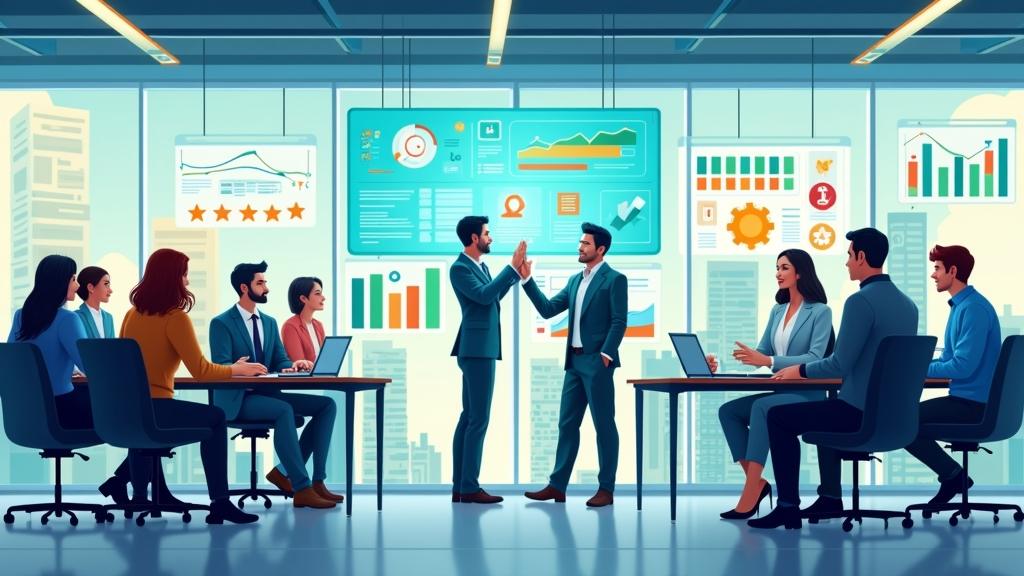
Another critical point is to avoid excessive competitiveness. Rankings can be useful, but if only the same three employees appear at the top, the rest will drop out. Solutions such as teams competing against each other or collective goals help with this.
What's more, the rewards need to be meaningful. A virtual badge can be fun, but if it's the only thing, the effect wears off quickly. Combine it with real benefits: time off, courses or even bonuses.
Finally, listen to the team's feedback. What motivates a group of engineers may not work for marketing. Gamification is not "one size fits all".
Tools and Technologies that Facilitate Gamification
There's no need to reinvent the wheel - several ready-made tools can help. Platforms such as Gametize allow you to create personalized challenges, while the Axonify is focused on corporate training with game elements.
For those who prefer simple solutions, even Microsoft Teams has integration with gamification apps. And CRM systems like Salesforce offer modules like "Salesforce Gamification", turning sales targets into epic battles.
But technology is only half the battle. The difference lies in creativity. An example? A logistics company created a "delivery simulator" where drivers competed for efficiency, reducing fuel costs by 15%.
How about starting with a pilot in a small sector before scaling up? Testing, adjusting and then expanding avoids wasted investment.
The Future of Gamification: Trends and Innovations
Gamification is evolving with technologies such as AI and virtual reality. Imagine safety training where employees "enter" a dangerous virtual environment and have to make decisions under pressure. Companies like Strivr already offer this.
Another trend is data-based gamification. Systems that analyze individual performance and adjust challenges automatically - like a game that gets harder as you improve.
And let's not forget social gamification, where remote teams collaborate on global missions. With the home office on the rise, maintaining engagement at a distance will be increasingly crucial.
In five years' time, will every HR person have a game designer on their team? The possibilities are endless.
Practical Tips to Get Started Today
Don't expect a million-dollar budget to test gamification. Small actions already make a difference:
1. Create a simple recognition systemas "Employee of the Week" in a vote by the team.
2. Turn goals into challenges - e.g. "If we achieve X sales, the team wins an afternoon of games".
3. Use free tools as Quizizz for interactive training.
4. Collect feedback and adjustment. Gamification is an iterative process.
Remember: the ultimate goal is not just to increase numbers, but to create an environment where people are happy to contribute. When work becomes fun, productivity is no longer a problem.
Are you ready to transform your team with gamification? How about starting with a small challenge this week?