
The Impact of the Pandemic on the Labor Market
The COVID-19 pandemic wasn't just a health crisis - it radically redefined the world of work. From one day to the next, entire professions were transformed, some disappeared and others emerged. Who would have thought, in 2019, that skills such as managing remote teams or mastering digital platforms would become essential? The home office, once an exception, has become the rule for millions of people. And while some companies have closed their doors, others have accelerated their digitization at an unprecedented pace.
A clear example is the retail sector. Physical stores have faced brutal drops in sales, while e-commerce has exploded. Those who didn't adapt were left behind. Professionals who previously worked in face-to-face service had to learn about logistics, CRM and even data analysis to keep up with the new demands. Have you ever stopped to think about how your area has been impacted? If the answer is no, maybe it's time to think about it.
In addition, automation and artificial intelligence have gained even more ground. Repetitive tasks, previously performed by humans, are now carried out by software. Banks, for example, have drastically reduced the number of human tellers and invested in chatbots and digital customer service. Is your job immune to these changes? Hardly. And that's where the urgent need for retraining comes in.
The [World Economic Forum] report points out that by 2025, 85 million jobs could be replaced by machines, while 97 million new functions will emerge - many of them requiring skills we haven't even mastered yet. The question that remains is: how can we prepare for this uncertain future, but one full of opportunities?
The Skills Most in Demand in the Post-Pandemic Scenario
If a degree used to be enough to guarantee a stable career, today it's just the first step. What really matters are the skills you master - and how they align with market needs. Soft skills such as resilience, creativity and adaptability are at the top of the list. After all, in a volatile world, those who don't know how to reinvent themselves are left behind.
But it's not just behavioral skills that are worth gold. Technical knowledge in areas such as data analysis, programming, digital marketing and project management are on the rise. An HR professional, for example, now needs to understand People Analytics in order to make decisions based on data. A salesperson needs to master tools such as CRM and marketing automation. Have you assessed whether your skills are up to date?
One emblematic case is Industry 4.0. Smart factories, with IoT (Internet of Things) and machine learning, require operators who know how to deal with robotics and integrated systems. Those who insist on old methods run the risk of being replaced. Courses such as those offered by [Senai] or platforms like [Coursera] can be great starting points for retraining.
And don't think that this only applies to technical areas. Even creative professions, such as design and communication, require new knowledge. Designers need to understand UX/UI, while journalists must know how to produce content for multiple platforms. What are you doing to stay relevant?
Why Vocational Retraining is No Longer Optional
Some still believe they can pursue careers without updating. But this is a dangerous illusion. The speed of technological change and the demands of the market have made retraining a necessity, not a differential. Anyone who doesn't invest in continuous learning is, consciously or not, giving up opportunities.
Imagine an accountant who still only works with manual spreadsheets, ignoring digital accounting tools like [ContaAzul] or [QuickBooks]. Before long, they will lose ground to professionals who master tax automation and predictive financial analysis. Do you want to be replaced or do you want to be the one who replaces you?
In addition, companies are increasingly valuing multidisciplinary professionals. An engineer who also understands project management has more chances of growth. A teacher who masters hybrid teaching tools stands out in a market that values digital education. What's the next step in your learning journey?
And it's not just about employability. Retraining brings psychological safety. In a world where mass layoffs have become common news, having versatile skills reduces anxiety and increases confidence. After all, if one door closes, others will open for those who are prepared.
How to start retraining without wasting time
Now that you understand the importance of retraining, the question arises: where to start? The first step is to make an honest diagnosis of your abilities. What are your strengths? And what gaps need to be filled? Tools like [LinkedIn Learning] offer skills tests and personalized courses.
Then define a plan of action. If you want to move into technology, for example, start with introductory programming courses on [Codecademy] or [Udemy]. If your focus is management, platforms such as [Fundação Getúlio Vargas] offer high-quality free courses. The important thing is not to stand still.
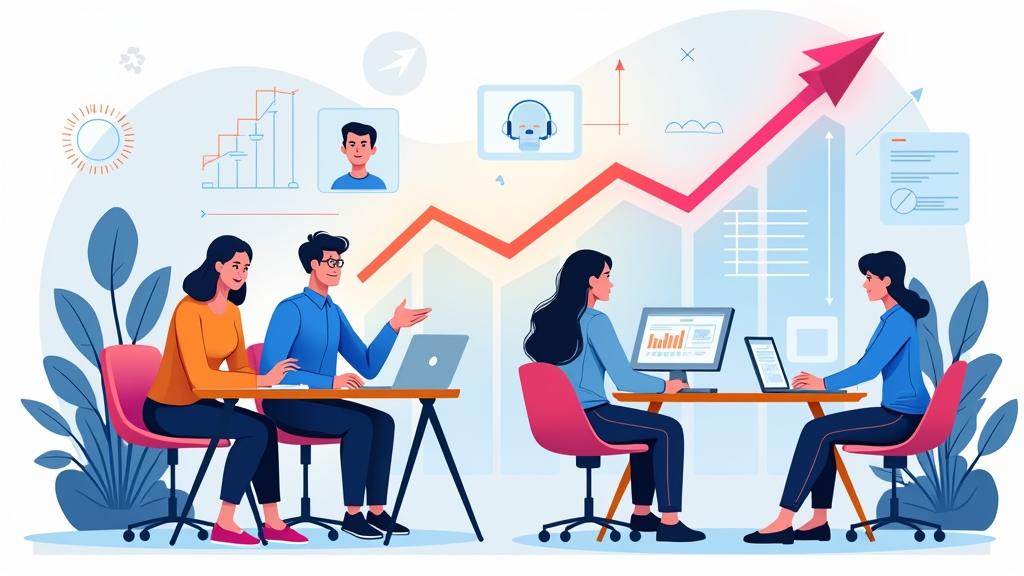
Another valuable tip is to look for mentoring and networking. Participating in professional communities on LinkedIn or forums like [Reddit] can open doors to exchanges of experience and even job opportunities. Have you thought about finding a mentor who has already gone through the transition you want to make?
And don't underestimate the power of small steps. You don't have to master everything at once. Start with micro-courses, apply the knowledge to your current job and work your way up. The important thing is to remain consistent. Remember: even a journey of a thousand kilometers begins with a single step.
The Role of Companies in Retraining Their Employees
While professionals need to take the initiative, companies also have a crucial responsibility. Investing in team development is not a cost - it's an investment. Up-to-date employees are more productive, innovative and loyal. Big companies like Google and Amazon have already understood this and offer ongoing upskilling programs.
A practical example is Magazine Luiza, which created the [Retail School] to train employees in new technologies in the sector. The result? Better prepared teams and a more competitive business. Does your company offer opportunities like this? If not, why not suggest it?
What's more, companies that don't adapt to the new demands for training run the risk of losing talent. Research shows that professionals value development more than traditional benefits such as meal vouchers. We're talking about a cultural change.
And it's not just about formal courses. Internal mentoring, job rotation and challenging projects are effective ways of retraining. How about proposing a study group in your company or a knowledge exchange program between departments?
Success stories: who retrained and stood out
Real stories inspire and show that retraining is possible. Takeo, a former machine operator, took robotics courses at Senai and is now a supervisor in an automated factory. He didn't wait for the change to come - he went for it.
Another case is that of Ana, an English teacher who, during the pandemic, learned how to create online courses. Today, she has multiplied her income and reaches students all over the country. She turned a crisis into an opportunity. You can too.
And don't think that this is just for young people. Carlos, 55, used to be a bank manager and reinvented himself as a digital financial advisor after taking courses in the area. Age is no excuse. The market values those who are willing to learn.
These examples show a pattern: he who acts first reaps the rewards. What about you? What are you waiting for to write your own success story?
Practical Tips for Staying Focused on the Reskilling Journey
Retraining isn't easy - it takes time, discipline and often leaving your comfort zone. But with the right strategies, you can make the process run more smoothly. First, set clear and measurable goals. Instead of "I want to learn digital marketing", say "I'm going to complete an SEO course in 30 days".
Secondly, create a study routine. Set aside at least 30 minutes a day to learn something new. Use techniques like Pomodoro to stay focused. Small habits generate big results.
Thirdly, don't be afraid to make mistakes. The learning curve is natural, and every mistake is a lesson. Share your doubts in forums or with colleagues - you're not alone on this journey.
Finally, celebrate every achievement. Have you completed a course? Applied new knowledge at work? Recognize your progress. Redevelopment is a marathon, not a sprint. And you've already taken the first step by reading this article. Now move on!