
The Revolution of Parallel Reality Architects in the Corporate World
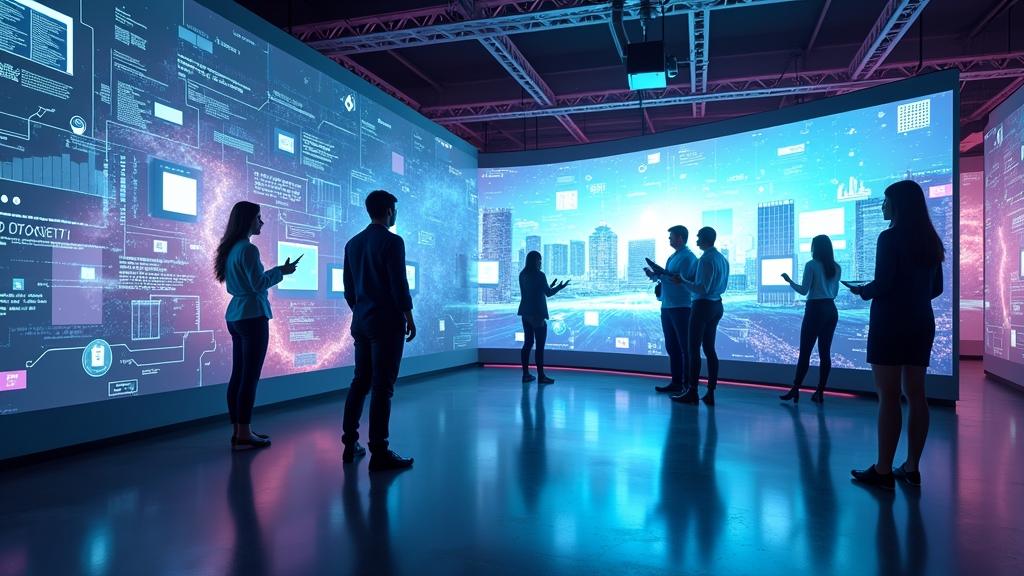
Imagine an office where you can walk around virtual rooms, interact with colleagues as if they were next to you and manipulate data with gestures in the air. Sound like science fiction? Not anymore. Professionals specializing in creating immersive environments are turning this vision into reality, radically redefining how we work and collaborate.
These "architects of parallel realities" combine design, technology and psychology to build digital spaces that transcend physical limitations. Whether in the metaverse or through augmented reality, they are shaping the future of remote working, corporate communication and even organizational culture.
But how exactly does this work? What skills do these professionals need to master? And, most importantly, what impact will this have on their day-to-day work? Let's explore these questions in depth.
The Rise of Immersive Working Environments
A decade ago, remote working was synonymous with static video calls and shared documents. Today, platforms such as Microsoft Mesh It is Meta Quest for Business allow meetings in personalized 3D spaces, where avatars express body language and virtual objects can be manipulated in real time.
Companies like Accenture have already created digital versions of their offices in the NVIDIA Omniversein which new employees receive immersive training before they even set foot in a physical building. PwC, for its part, found that employees trained in virtual reality learned up to four times faster than in traditional classes.
Why is this change happening now? The convergence of three factors: more affordable hardware (such as VR glasses under US$ 300), ultra-fast connections (5G and Wi-Fi 6) and a generation of professionals who have grown up in digital worlds. When 62% of millennials prefer flexible working environments (data from Deloitte Global Millennial Survey), immersion becomes a strategic talent retention tool.
But creating these spaces goes far beyond transferring a meeting room to digital. It requires a new type of professional - someone who understands both virtual ergonomics and team dynamics. Someone who can answer the question: how do you make brainstorming in VR feel as natural as it does on a physical whiteboard?
The Multidisciplinary Profile of Parallel Reality Architects
These professionals rarely come from a single background. You'll find former game designers now creating virtual offices, sound engineers specializing in digital ambience and even anthropologists studying how corporate cultures form in spaces without physical geography.
Takeo Igarashi, a researcher at the University of Tokyo, has developed tools that allow 3D rooms to be "designed" with hand gestures - a skill now essential for rapid prototyping of virtual spaces. Meanwhile, companies such as Varjo focus on extreme visual fidelity, creating headsets with a resolution comparable to the human eye for professional applications.
What skills define these digital architects? First, proficiency in 3D engines (Unity, Unreal Engine) and parametric modeling. Second, notions of environmental psychology - how colors and shapes affect productivity in gravity-free spaces. Thirdly, an in-depth understanding of corporate workflows in order to translate them into intuitive interactions.
An emblematic case: the Salesforce designed its "Trailhead VR" for onboarding, where new hires navigate gamified missions that teach CRM while collecting virtual items. The result? 40% more engagement in training. This requires not only technicians, but storytellers who know how to use immersive narratives for educational purposes.
And demand is exploding. According to LinkedInIn 2022, advertisements for "immersive experience designers" grew by 400%. Universities like USC already offer master's degrees in Spatial Computing, while bootcamps focused on UX for XR are proliferating.
Radical redesign of remote collaboration
Zoom tired you out? In immersive environments, a meeting can take place on an alien planet (for creativity) or in a digital replica of the office (for routines). A TeamViewer allows technicians to guide repairs remotely via AR, overlaying instructions directly onto the actual machinery.
In practice: BMW engineers use HoloLens 2 glasses to design full-scale vehicles, walking around 3D models that multiple teams manipulate simultaneously. Design errors are identified 30% faster, saving millions on physical prototypes.
How does this change team dynamics? Gartner studies show that shared spatial presence reduces "digital fatigue" - our brains process 3D avatars as more authentic interactions than flat screens. Startups like Gather recreate the serendipity of hallway conversations with pixelated offices where you "approach" avatars to initiate calls.
But there are challenges. Not all tasks benefit from immersion - reports are still faster on physical keyboards. And if poorly designed, these spaces can cause virtual sickness or sensory overload. The solution? Architects of parallel realities are developing "immersion protocols": when to use full VR, when AR holograms will suffice and when to go back to good old email.
Impact on Organizational Culture and Well-Being
Immersive environments aren't just about productivity - they're reshaping how companies cultivate belonging. The consultancy Accenture holds happy hours on its virtual "Nth Floor", where employees customize avatars and play trivia between digital buildings. The result: remote teams report a greater emotional connection.
What about well-being? Applications such as Tripp offer VR meditation rooms with dynamic landscapes that respond to your heart rate. Virtual offices can have "decompression zones" with forest sounds or views of space - something impossible in real open spaces.
A Stanford University experiment revealed that customizable avatars increase self-confidence in meetings, especially for introverted professionals. On the other hand, there are risks: without clear boundaries, immersive work can further blur the lines between personal and professional life.
Pioneering companies are creating "immersive codes of conduct": closing times for virtual worlds, "rest mode" options for avatars and even training to avoid harassment in digital spaces. After all, if a