The Phenomenon of Professional "Nomadization": How the Search for Purpose and Mobility is Redefining Employment Contracts and Relationships in the 21st Century
The Rise of Digital Nomadism
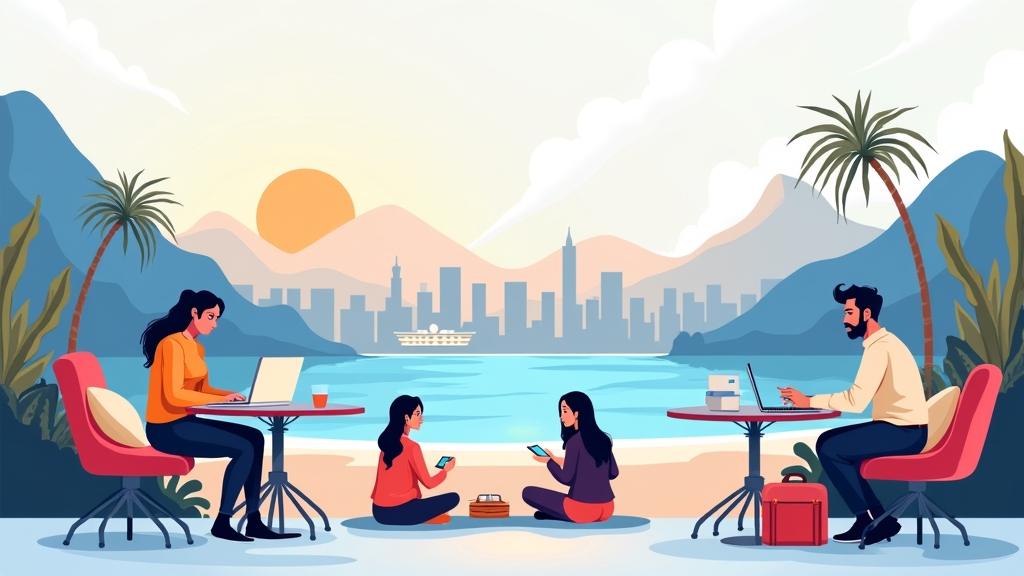
Imagine waking up on a paradise beach, opening your laptop and starting to work while listening to the sound of the waves. Sound like a distant dream? For many, this is reality. O digital nomadism has emerged as a movement that combines remote work with the freedom to travel the world. Professionals from various fields - from developers to designers, copywriters and consultants - are swapping fixed offices for coworkings in Bali, cafés in Lisbon or even vanlifts in the interior of Brazil.
But what is driving this change? The answer lies in the search for autonomy and purpose. A study of the Buffer reveals that 98% of remote professionals would like to continue working this way for the rest of their lives. Technology, of course, is the great enabler: platforms such as Zoom, Slack and Trello allow global collaboration in real time.
However, it's not all flowers. The lack of a fixed structure can lead to loneliness and difficulty separating personal and professional life. How do you balance freedom and responsibility? Some nomads adopt rigid routines, while others prefer spontaneity. The key is to experiment and adapt.
There is no shortage of inspiring examples. Brazilian Carol Sandler, for example, left a corporate job in São Paulo to become a digital nomad and today teaches others to do the same through her blog I want to travel more. Stories like hers show that, with planning and resilience, it is possible to turn a nomadic lifestyle into a sustainable career.
The Transformation of Employment Contracts
Gone are the days when a 9-to-5 job with a permanent contract was the ultimate career goal. The rise of the gig economy and remote work has led to more flexible arrangements, such as freelance, project-based, and outcome-driven contracts. Companies like Upwork and Toptal have become hubs for professionals seeking short-term engagements with global clients.
This shift isn't just about convenience-it's about redefining value. Instead of being paid for hours worked, many professionals are now compensated based on deliverables. A graphic designer in Rio might charge per logo created, while a software developer in Berlin could earn per completed feature. This model benefits both parties: workers gain flexibility, and employers access specialized skills without long-term commitments.
However, this new landscape isn't without challenges. Job security becomes a concern when income fluctuates monthly. Benefits like health insurance and retirement plans, traditionally provided by employers, now fall on the individual. Platforms like SafetyWing offer solutions with global health coverage tailored for digital nomads, but the responsibility still lies with the worker.
So, is the traditional employment model dying? Not necessarily. Hybrid approaches are emerging, where companies maintain core teams but outsource niche tasks. The key takeaway? Adaptability is the new job security. Professionals who diversify their skills and income streams will thrive in this evolving market.
The Impact on Company-Employee Relations
If loyalty to a company used to be measured in decades, today it can be counted in projects. A professional nomadization is profoundly changing the dynamic between employers and employees. Companies such as Automattic (creator of WordPress) operate with 100% remote teams, prioritizing results over physical presence.
But how do you keep employees engaged when they're spread all over the world? The answer lies in adaptive organizational culture. Relaxed virtual meetings, online mentoring programs and annual retreats are some of the strategies adopted. Basecamp, for example, uses internal tools such as the HEY to facilitate communication without overloading the team.
On the other hand, professionals also need to adapt. Digital networking it becomes essential to participate in communities such as Nomad List or LinkedIn groups can open doors to unexpected collaborations. The story of Spaniard Pablo Fernandez, who got his first international client through a nomad forum, illustrates this scenario well.
What about hierarchies? They are becoming more horizontal. Instead of controlling bosses, facilitating leaders are emerging. Trust is replacing micro-management. Is this the natural evolution of the job? Everything points to yes, but the road is still being paved.
Psychosocial Challenges of the Nomadic Lifestyle
Geographical freedom has its price. A loneliness is one of the biggest challenges faced by digital nomads. A study by Remote.co points out that 21% of remote workers suffer from social isolation. Without office colleagues or happy hours after work, building deep connections requires extra effort.
Another obstacle is the emotional instability. Traveling constantly can be exciting, but also exhausting. Jet lag, visa bureaucracy and the difficulty of putting down roots affect even the most experienced travelers. Australian Jessica Smith, who documents her journey on her blog WanderessShe says she had to go to therapy to deal with the anxiety of not having a "fixed home".
What about productivity? Working in different time zones can mean late nights on calls or missed deadlines. Tools such as World Time Buddy help organize schedules, but personal discipline is irreplaceable. Would you be willing to trade comfort for adventure?
Despite the setbacks, many say it's worth it. Support communities such as Digital Nomad GirlsThey offer welcoming networks. The secret lies in balancing freedom with self-knowledge - knowing when to stop and recharge.
The Role of Cities and Countries in this Scenario
Some places are becoming real magnets for digital nomads. Destinations such as Chiang Mai (Thailand), Lisbon (Portugal) and Medellín (Colombia) offer accessible infrastructure, fast internet and specific visas, such as the Dubai Digital Nomad Visa.
But what impact will this have on local economies? Small towns can be revitalized by the arrival of these professionals - an increase in consumption in cafés, coworkings and rental properties. On the other hand, there is a risk of gentrification. In Bali, for example, the cost of living has risen so much that some old residents have been forced to move away.
Governments are taking note. Iceland has launched a program to attract nomads during the winter, while Brazil discusses regulations for international remote work. Is your country prepared for this wave?
For nomads, the tip is to do your research before you migrate. Sites such as Numbeo compare living costs, while Facebook groups provide real-time reports. Choosing a destination goes beyond beauty - it's about finding a balance between quality of life and professional opportunities.
Essential tools for the nomadic professional
Success in digital nomadism requires more than a passport full of stamps. You need to master tools that maintain productivity anywhere in the world. Starting with organization: apps like Trello It is Notion help manage projects and deadlines visually.
Communication is also crucial. In addition to the classic Slackplatforms such as Discord are being used by distributed teams. And for meetings? O Around offers video calls with less eye strain - ideal for those who are always on the move.
Security cannot be neglected. A VPN protects data on public networks, while services such as Revolut simplify international transactions without abusive fees. Have you ever thought about the chaos of losing your laptop in the middle of a trip? Cloud backups (Google Drive, Dropbox) are a lifesaver.
And most importantly: tools for quality of life. O Headspace helps with meditation during airport layovers, and the Rome2Rio plan routes between cities. With the right combination of apps, you can work efficiently - whether in a hostel or at a viewpoint at the top of the Andes.
The Future of Work: Where Does It All Lead?
A professional nomadization is not a passing fad - it's a response to the demands of the 21st century. As AI and automation advance, skills such as adaptability and creativity become valuable currencies. Companies that resist flexibility could lose talent to more agile competitors.
But what about traditional jobs? They won't disappear, but they will change. Sectors such as health and education are already testing hybrid models. Universities offer global online courses (such as those at Coursera), and hospitals use telemedicine. Are we moving towards a world without professional boundaries?
For individuals, the challenge is to develop a anti-fragile mentality-Able to thrive on change. This means continuously learning, building a personal brand and cultivating diverse networks. Mexican Carlos Morales, who migrated from accountant to cryptocurrency consultant while traveling, exemplifies this capacity for reinvention.
The future belongs to those who see work not as a place, but as a purposeful activity. Whether you choose to be a nomad or opt for a fixed home office, the essential thing is to finding a balance that feeds your passion and sustains your lifestyle. So, are you ready to rethink your career?
This article has taken a deep dive into the nuances of professional nomadization - from the opportunities to the challenges. Whether you're getting inspired for your first trip or adapting your company to this trend, the important thing is to get started. How about sharing your experiences in the comments? Dialogue enriches the journey for all of us.