The Rise of "Net Jobs": The New Normal in the Labor Market
Imagine a world where your job today won't be the same in six months' time. Where skills you master now may become obsolete in a short time, and where the ability to adapt is worth more than years of experience in a single area. This scenario isn't science fiction - it's the reality of net jobsThis is a concept that is transforming careers and demanding a completely new mindset about work and professional development.
In this article, we'll explore how fluidity in professional roles is becoming the norm, what skills are essential to navigate this new landscape and how you can prepare for a future where the only constant is change.
What Are Net Jobs and Why Are They Emerging?
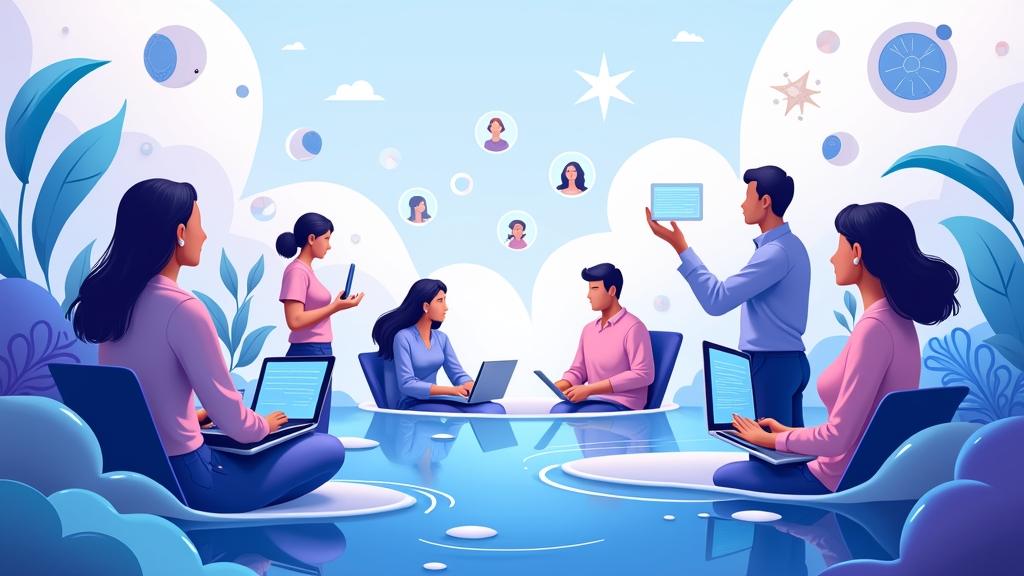
The metaphor of liquid comes from sociology, inspired by the concept of liquid modernity by the thinker Zygmunt Bauman. Whereas before careers were like solid structures - stable and predictable - today they resemble fluids, molding according to the environment. But what is behind this transformation?
First, the technological acceleration. New tools are emerging at an exponential rate, making some professions obsolete and creating others that didn't even exist five years ago. One example? A decade ago, few would have imagined that blockchain experts or virtual community managers would be such sought-after positions.
Secondly globalization and the network economy. Companies operate in multiple time zones, projects are carried out by distributed teams and competition is no longer limited to the local market. This requires professionals who can move between different cultural and operational contexts.
Thirdly changing expectations of new generations. Millennials and Gen Z are looking for purpose and flexibility, not just stability. They are more willing to change areas, experiment with side projects and even create their own career paths.
Finally pandemic accelerated this trend. Remote working has shown that functions can be performed from anywhere, and many companies have realized that multidisciplinary and adaptable teams are more resilient in crisis scenarios.
How does job fluidity impact traditional careers?
If before an engineer spent his life designing structures or an accountant dedicated decades to the same company, today these linear trajectories are increasingly rare. The fluidity of functions is challenging traditional careers in three main ways:
1. The death of deep specialization in a single area
Professionals who limit themselves to a single niche are at risk. A lawyer who only knows labor law could lose ground to another who also understands technology and digital compliance. Similarly, a journalist who only writes for print faces difficulties if they don't master SEO, video and data analysis.
2. The need for continuous learning
It's not enough to go to university and stop studying. Short courses, certifications and microlearning are becoming essential. Platforms such as Coursera It is Udemy offer training in emerging skills, from artificial intelligence to digital marketing.
3. Valuing transversal skills
Soft skills such as resilience, communication and critical thinking are now just as important as technical knowledge. A study by World Economic Forum lists creativity and cognitive flexibility among the skills most in demand by 2025.
4. The rise of project work
Many companies are swapping fixed positions for temporary teams set up for specific demands. Professionals have to get used to moving between projects, sometimes in different companies, without the security of a permanent contract.
What are the Essential Skills to Survive in this Scenario?
If liquid jobs are the future, how can you prepare? Some skills stand out, such as anchors in the midst of so much instability:
1. Adaptability and growth mindset
Carol Dweck, a Stanford psychologist, coined the term growth mindset to describe the belief that skills can be developed. In a liquid world, those who think they "know enough" are left behind.
2. Digital literacy
You don't have to be a programmer, but understanding the basics of data, automation and digital tools is crucial. Even traditional professions such as medicine and law are being impacted by AI and analytics.
3. Emotional intelligence
How do you deal with frustration, manage remote teams and negotiate in uncertain environments? The ability to read social situations and maintain emotional balance will be a plus.
4. Ability to learn quickly
Micro-certifications, bootcamps and even the self-learning via YouTube and podcasts are ways to stay relevant. Platforms such as LinkedIn Learning offer personalized tracks for different careers.
How Are Companies Adapting to This New Reality?
Organizations that resist change are losing out on talent and opportunities. Some strategies are already being adopted by innovative companies:
1. more horizontal organizational structures
Rigid hierarchies are giving way to agile models, where multidisciplinary teams form and dissolve as needed.
2. Investment in upskilling and reskilling
Large corporations such as IBM and Amazon are offering massive training to relocate employees to new roles.
3. Culture of continuous feedback
Annual appraisals are being replaced by frequent check-ins, allowing for quick adjustments to employees' careers.
4. Flexibility as a priority benefit
Home office, adaptable hours and even the possibility of working on parallel projects are used to attract and retain talent.
What Can You Do Today to Prepare?
Don't wait for your company or your government to sort it out for you. The responsibility for your professional development now lies with your. Here are some practical actions:
1. map your skills and gaps
Tools such as My Next Move help identify skills in demand.
2. Experiment with different areas
Take courses outside your comfort zone. A designer learning programming or a teacher studying video editing increases your range of opportunities.
3. Build a diverse network
Connect with people from other areas. Who knows, maybe your next project will come from a conversation with a professional from a completely different sector?
4. Be open to reinvention
It can be daunting to change careers in your 40s or 50s, but stories like that of professionals who reinvented themselves after 50 show that it is possible.
Conclusion: The Future is for the Adaptable
Liquid jobs are not a passing fad - they are a reflection of a world undergoing rapid change. The good news? Those who develop adaptability, curiosity and resilience will have a better chance of prospering.
Have you noticed how your career is becoming more fluid? What skills do you want to develop in the coming months? Share your thoughts and let's navigate this new world of work together!